
LNH31.
Cross-border trade · B2B · Amazon
Operations11·
Export Packaging for Temperature and Humidity Protection: Best Practices
Best practices for export packaging to protect products from temperature and humidity damage during international shipping from Taiwan to the US, Australia, and Japan.
export packaging humiditymoisture barrier packagingtemperature controlled shippingdesiccant packagingcontainer rain prevention
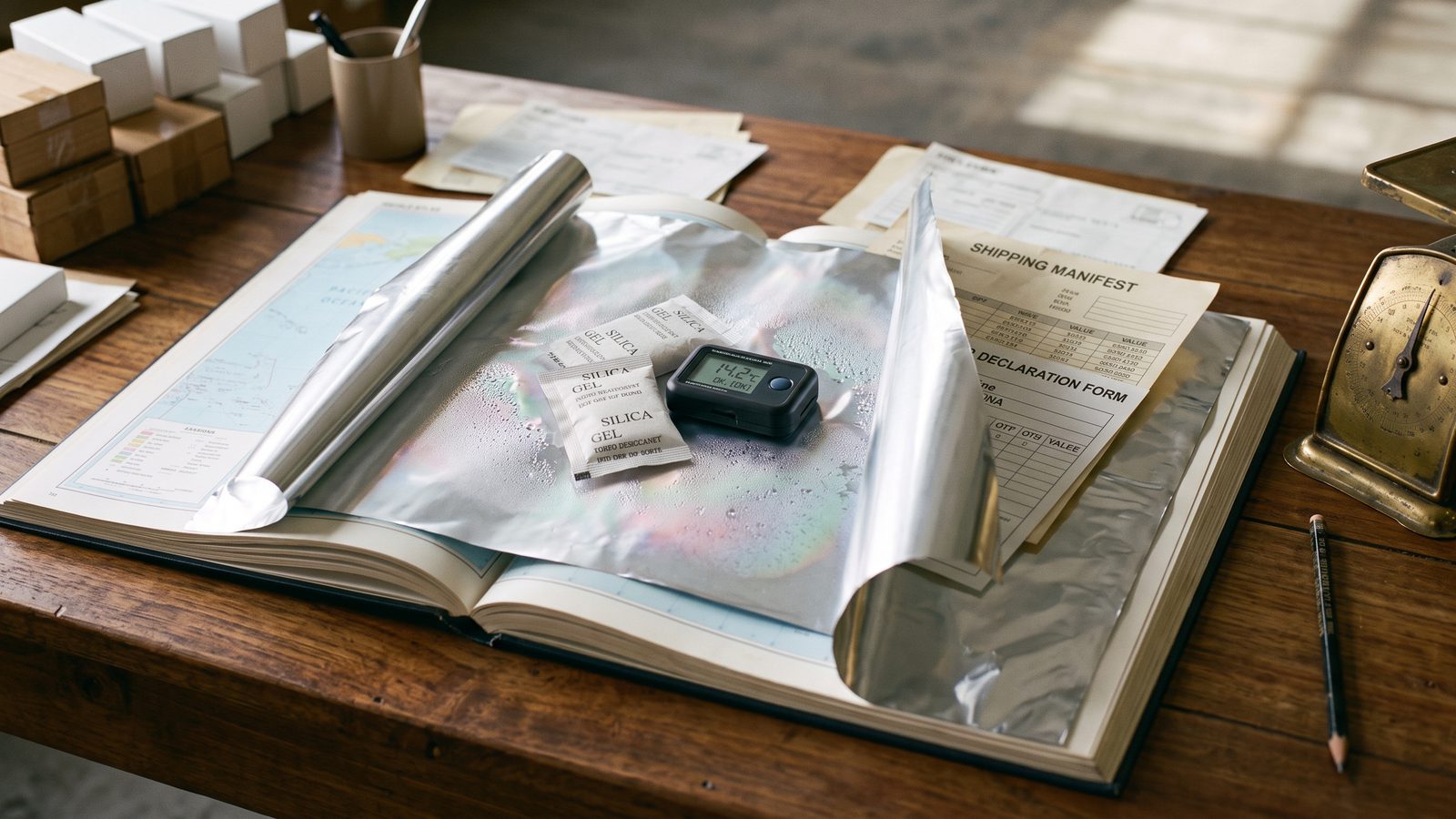
Climate Risks on Shipping Routes from Taiwan to Key Export Markets
Taiwan's geographic location in the subtropical zone, combined with the climate diversity of its three primary export markets, creates significant temperature and humidity management challenges for export packaging. Sea freight shipments from Kaohsiung or Keelung to Los Angeles traverse the Pacific Ocean, where container internal temperatures can reach 60 to 70 degrees Celsius during summer months due to solar radiation on the container roof, and internal humidity levels can exceed 95 percent relative humidity (RH) during passage through tropical waters. The 14 to 21 day transit time through these conditions means that products spend extended periods in a hostile climate environment.
The Australia route (Kaohsiung/Keelung to Sydney or Melbourne) passes through equatorial waters and the Coral Sea, where ambient temperatures consistently exceed 30 degrees Celsius and humidity is above 80 percent RH. Transit times of 12 to 18 days expose products to sustained high-temperature, high-humidity conditions. The Japan route (Kaohsiung/Keelung to Tokyo, Osaka, or Yokohama) is the shortest at 3 to 7 days but presents unique challenges during the rainy season (June to September), when extreme humidity can cause "container rain" (condensation that forms on the container ceiling and drips onto cargo) even during short transits.
Container rain, also called container sweat or cargo sweat, is the most common cause of moisture damage to containerized cargo and occurs when the temperature inside the container drops below the dew point of the internal air. This happens most frequently when a container loaded in warm, humid conditions (such as a Taiwan summer warehouse) is transported through cooler waters or arrives at a cooler destination port. The moisture-laden air inside the container cools, reaches saturation, and condenses on the container ceiling and walls. The condensation drips onto the top layer of cargo, causing water staining, mold growth, corrosion, label damage, and in severe cases, structural damage to cartons and product contamination.
Statistics from international cargo insurance providers indicate that approximately 9 percent of all containerized cargo claims are related to moisture and humidity damage, representing an estimated USD 2.6 billion in annual losses globally. For Taiwan exporters shipping moisture-sensitive products (electronics, food products, textiles, pharmaceuticals, paper goods, and metal components), the financial impact of a single moisture-damaged shipment can be substantial. A container of consumer electronics valued at USD 150,000 to USD 300,000 can be rendered unsaleable by moisture-induced corrosion on circuit boards or mold growth on packaging. Investing USD 200 to USD 800 in proper moisture protection per container is one of the highest-ROI risk mitigation measures available to exporters.
Temperature extremes also pose risks beyond humidity. Products with temperature-sensitive components, such as lithium batteries (which can become unstable above 60 degrees Celsius), cosmetics and personal care products (which can separate or degrade), chocolate and confectionery (which melt above 30 degrees Celsius), and pharmaceutical products (which may lose efficacy), require additional thermal protection measures. Understanding the specific climate risks on each shipping route allows Taiwan exporters to design packaging solutions that are appropriately protective without being unnecessarily costly.
Desiccant Types, Quantities, and Moisture Barrier Packaging
Desiccants are moisture-absorbing materials placed inside product packaging or shipping containers to reduce the relative humidity of the enclosed air space and protect products from moisture damage. The three most commonly used desiccant types for export packaging are silica gel, calcium chloride (CaCl2), and clay (montmorillonite). Each type has different absorption capacities, cost profiles, and appropriate applications. Selecting the right desiccant type and quantity is critical because under-desiccation provides insufficient protection while over-desiccation wastes money and can, in some cases, cause product issues (such as cracking of leather goods or warping of wood in excessively dry conditions).
Silica gel is the most widely used desiccant for product-level packaging. It absorbs approximately 20 to 35 percent of its weight in moisture at 60 percent RH and 25 degrees Celsius. Silica gel is chemically inert, non-toxic, and FDA-approved for use in contact with food packaging. Standard silica gel packets (1g to 100g) are placed inside individual product packaging to maintain low humidity around the product during storage and shipping. The required quantity depends on the volume of air inside the package, the permeability of the packaging material, and the desired target humidity level. A general guideline for electronics packaging is 3 to 5 grams of silica gel per liter of enclosed air volume for a target humidity below 40 percent RH. Silica gel costs approximately USD 3 to USD 8 per kilogram in bulk quantities.
Calcium chloride (CaCl2) desiccants are the preferred solution for container-level moisture protection because of their dramatically higher absorption capacity. CaCl2-based container desiccants (such as Absortech AbsorGel, Clariant Container Dri, or Super Dry brands) can absorb 200 to 300 percent of their weight in moisture, making them highly effective at preventing container rain in large air volumes. A standard 20-foot container with approximately 33 cubic meters of internal volume requires 6 to 12 kg of CaCl2 desiccant (typically provided as 2 to 4 hanging units or blankets) at a cost of USD 50 to USD 150 per container. The desiccants are hung from the container ceiling or lashing rings and actively absorb moisture from the air throughout the transit, converting it to a gel that remains trapped inside the desiccant housing.
Moisture barrier bags (MBBs) provide a sealed environment that prevents external moisture from reaching the product. Military-specification MBBs conforming to MIL-PRF-22019 (formerly MIL-B-22019) are the gold standard for electronics and metal component protection, using multi-layer laminated films (typically polyester/aluminum foil/polyethylene) that provide moisture vapor transmission rates (MVTR) of less than 0.02 g/m2/24 hours. Products are placed inside the MBB along with an appropriate quantity of desiccant, and the bag is heat-sealed to create a hermetic barrier. MBBs are available in standard sizes from manufacturers such as Protective Packaging Corporation, Shield Pack, and Oji Interpack, with costs ranging from USD 0.50 to USD 5.00 per bag depending on size.
The combination of product-level silica gel desiccant inside moisture barrier bags plus container-level CaCl2 desiccant provides comprehensive moisture protection for the most sensitive cargo. For typical consumer electronics shipments from Taiwan, this dual-layer approach adds approximately USD 0.30 to USD 1.50 per unit in packaging material costs plus USD 50 to USD 150 per container for container desiccant. Given that the potential loss from a single moisture-damaged container can range from USD 50,000 to USD 300,000, the cost-to-benefit ratio strongly favors investment in proper moisture protection for every shipment.
Temperature Monitoring, Insulated Shipping, and ISTA 7D Testing
Temperature indicators and data loggers provide critical evidence of the temperature conditions experienced by products during transit, serving both as quality assurance tools and as documentation for insurance claims if temperature excursions cause product damage. Single-use temperature indicators (such as 3M MonitorMark, Timestrip, or ColdMark) are adhesive labels that irreversibly change color when the temperature exceeds or falls below a preset threshold. These indicators cost USD 0.50 to USD 3.00 each and provide a simple pass/fail indication without recording the duration or magnitude of the temperature excursion.
Electronic temperature and humidity data loggers (such as Sensitech TempTale, Emerson GO Real-Time, or Testo 184 series) continuously record temperature and humidity at programmable intervals (typically every 5 to 15 minutes) throughout the entire transit period. At the destination, the data logger is connected to a computer via USB or NFC to download the complete time-temperature history. Reusable loggers cost USD 30 to USD 150 per unit, while single-use disposable loggers cost USD 8 to USD 25 per unit. For high-value shipments or temperature-critical products, real-time GPS-enabled trackers (such as Sensitech SensiWatch, Emerson GO Real-Time, or Orbcomm) transmit location and temperature data via cellular networks at intervals throughout transit, allowing the shipper and receiver to monitor conditions in real-time and take corrective action if excursions are detected. Real-time trackers cost USD 50 to USD 200 per trip.
Insulated shipping containers and thermal liners provide passive temperature protection by slowing heat transfer between the external environment and the cargo. Container liners made from reflective foil-faced foam (such as Insulated Covers, ThermoSafe, or Coldtainer products) are installed inside standard shipping containers and can reduce temperature extremes by 10 to 15 degrees Celsius. A standard 20-foot container liner costs USD 150 to USD 400 and takes approximately 30 minutes to install. For products requiring stricter temperature control, actively cooled containers (reefer containers) maintain a set temperature throughout transit at an additional cost of USD 1,500 to USD 3,500 per shipment compared to dry containers, plus electricity charges at the port during storage.
ISTA 7D (International Safe Transit Association Test Series 7D) is the industry-standard testing protocol for validating thermal packaging performance for temperature-sensitive products. ISTA 7D simulates real-world shipping conditions including temperature cycling, solar radiation, wind exposure, and various handling scenarios over a multi-day test period that replicates the conditions experienced during international air and ocean transit. Products intended for temperature-controlled distribution should undergo ISTA 7D testing at an accredited laboratory (such as Smithers-Pira, Westpak, or SGS) to validate that the packaging design maintains the required temperature range throughout the simulated transit period. Testing costs range from USD 3,000 to USD 8,000 per packaging configuration.
For Taiwan exporters shipping temperature-sensitive products to the US, Australia, and Japan, the recommended approach combines passive thermal protection (container liners for sea freight) with active monitoring (data loggers in every shipment) and validated packaging design (ISTA 7D tested for products with strict temperature requirements). The total cost of this comprehensive temperature management program adds approximately USD 200 to USD 600 per container for non-refrigerated shipments and USD 1,500 to USD 4,000 per container for refrigerated shipments. These costs are recoverable through reduced product damage claims, lower insurance premiums (many cargo insurers offer premium discounts for documented temperature management programs), and improved buyer confidence in product quality.
Humidity Damage Prevention and Specific Considerations for Taiwan-Origin Shipments
Preventing humidity damage in Taiwan-origin shipments starts at the factory, before the container is even loaded. Taiwan's average relative humidity ranges from 70 to 85 percent throughout the year, with summer months (June to September) frequently exceeding 90 percent RH. Products stored in non-climate-controlled Taiwan warehouses absorb ambient moisture, and when those products are sealed inside a container, the trapped moisture becomes the source of condensation and damage during transit through cooler waters. The most effective prevention measure is to pack products in a climate-controlled environment maintained below 60 percent RH, and to load containers in the early morning when ambient humidity is lowest.
Container loading best practices for humidity-sensitive cargo include pre-inspecting the container for cleanliness, structural integrity, and absence of moisture (wet container floors from previous cargo or rain are a common contamination source), lining the container floor with moisture-absorbing dunnage mats or kraft paper to absorb any residual floor moisture, installing container desiccant units immediately after the first row of cargo is loaded (not waiting until the container is fully loaded, as this exposes the first-loaded cargo to ambient humidity during the remaining loading time), and sealing the container as quickly as possible after loading is complete to minimize additional humid air ingress.
For specific product categories commonly exported from Taiwan, humidity damage manifests differently and requires tailored prevention approaches. Electronics suffer corrosion on circuit boards, connector contacts, and metal housings, with visible damage (white oxidation spots, greenish patina on copper) and invisible damage (increased contact resistance leading to intermittent failures). Prevention requires MIL-PRF-22019 moisture barrier bags with silica gel desiccant at the individual product level. Textiles and garments develop mold, mildew, and musty odors that are extremely difficult to remove and typically render the products unsaleable. Prevention requires polyethylene overwrap, silica gel in individual polybags, and container desiccant. Food products experience moisture migration that changes texture, promotes mold growth, and accelerates staling. Prevention requires moisture barrier packaging, oxygen absorbers (for mold prevention), and strict temperature control.
Metal components and hardware exported from Taiwan face particular corrosion risks during Pacific transit. Bare steel, zinc-plated, and chrome-plated surfaces are all susceptible to white rust (zinc corrosion), red rust (iron corrosion), and staining from condensation contact. Vapor-phase corrosion inhibitor (VCI) packaging, which releases molecular corrosion inhibitors that form a protective layer on metal surfaces, is the industry-standard solution. VCI packaging is available as treated paper (wrapping individual parts), VCI poly bags, and VCI emitter sachets placed inside sealed packaging. Major VCI suppliers include Cortec Corporation (VpCI products), Daubert Cromwell, and Zerust. VCI packaging adds approximately USD 0.10 to USD 0.50 per piece to packaging costs but virtually eliminates corrosion-related returns and claims.
Insurance and claims considerations: cargo insurance policies covering "all risks" typically include moisture and humidity damage, but many policies contain exclusions for "inherent vice" or "insufficiency of packing" that insurers may invoke to deny claims if the shipper failed to take reasonable moisture protection measures. Documenting the moisture protection measures taken for each shipment (type and quantity of desiccant, presence of moisture barrier packaging, container desiccant installation, pre-loading humidity measurements) creates an evidence file that strengthens insurance claims if damage occurs despite reasonable precautions. Some cargo insurers, including TT Club and Zurich Marine, offer premium discounts of 5 to 15 percent for shippers who demonstrate systematic moisture management programs with documented procedures.
Frequently Asked Questions
How much container desiccant do I need for a 20-foot container?
A standard 20-foot container with approximately 33 cubic meters of internal volume requires 6 to 12 kg of calcium chloride (CaCl2) based container desiccant, typically provided as 2 to 4 hanging units or strip/blanket systems. The exact quantity depends on transit duration, route climate conditions, and the moisture sensitivity of the cargo. For the Taiwan-to-US Pacific route in summer (the highest-risk scenario), use the maximum 12 kg. For the shorter Taiwan-to-Japan route, 6 to 8 kg is typically sufficient. Cost is USD 50 to USD 150 per container.
What is container rain and how do I prevent it?
Container rain (also called container sweat) is condensation that forms on the container ceiling and walls when moisture-laden air inside the container cools below its dew point. It drips onto cargo, causing water staining, mold, corrosion, and label damage. Prevention requires three measures: (1) pack products in a climate-controlled environment below 60 percent RH, (2) install CaCl2 container desiccant units (6 to 12 kg per 20-foot container) immediately during loading, and (3) load containers during the coolest, driest part of the day. These measures reduce container rain risk by approximately 85 to 95 percent.
Do I need temperature monitoring for every shipment?
For temperature-sensitive products (food, pharmaceuticals, cosmetics, lithium batteries, chocolate), yes, every shipment should include at least one electronic data logger (USD 8 to USD 25 for single-use). For non-temperature-sensitive products like general consumer electronics or textiles, temperature monitoring is recommended for the first few shipments to establish a baseline understanding of transit conditions, after which monitoring can be reduced to periodic spot-checks (every 5th to 10th shipment). Real-time GPS trackers (USD 50 to USD 200 per trip) are justified for high-value shipments exceeding USD 50,000.
What is MIL-PRF-22019 and when should I use moisture barrier bags?
MIL-PRF-22019 is a US military specification for moisture barrier bags (MBBs) made from multi-layer laminated films (polyester/aluminum foil/polyethylene) that provide near-zero moisture vapor transmission. Use MBBs for any product where moisture exposure causes irreversible damage: electronics (circuit board corrosion), precision metal parts (rust and oxidation), optical equipment (lens fogging), and pharmaceutical products (degradation). Each MBB should contain silica gel desiccant sized at 3 to 5 grams per liter of enclosed air volume. MBB costs range from USD 0.50 to USD 5.00 per bag depending on size.
Sources & References
- —International Safe Transit Association -- ISTA 7D: Thermal Transport Packaging Performance Testing 2023
- —Container Owners Association -- Guidelines for the Prevention of Cargo Sweat Damage in Shipping Containers 2024
- —MIL-PRF-22019 -- Performance Specification: Barrier Materials, Flexible, Electrostatic Protective, Heat Sealable
- —TT Club / UK P&I Club -- Cargo Integrity: Container Rain and Moisture Damage Prevention Guidelines 2025
Ready to Enter the US Market?
We turn great products into global sales. Contact us today.
Start a partnershipMore Articles
View All →

Cross-Border Trade
How Trade Shows Generate Export Leads: A Practical Guide for Taiwan Brands
8 min read