
LNH31.
Cross-border trade · B2B · Amazon
Operations13·
Cross-Border Trade Show Exhibition Logistics: Complete Planning Guide
Complete logistics guide for Taiwan brands exhibiting at international trade shows, covering ATA Carnet, booth shipping, sample customs clearance, show services, and budget planning for CES, Natural Products Expo, Tokyo Gift Show, and Fine Food Australia.
trade show logisticsATA carnetinternational exhibition planningtrade show freighttaiwan trade show
Strategic Value of International Trade Shows for Taiwan Brands
International trade shows remain one of the most effective market entry channels for Taiwan brands seeking to establish relationships with US, Australian, and Japanese buyers. Despite the growth of digital sourcing platforms, 78 percent of B2B buyers surveyed by the Center for Exhibition Industry Research (CEIR) in 2025 reported that they made purchasing decisions based on products they discovered at trade shows. The in-person experience allows buyers to evaluate product quality, test functionality, assess brand presentation, and build personal relationships with suppliers, all of which are critical factors in cross-border B2B purchasing decisions where trust and reliability are paramount.
The key trade shows relevant to Taiwan exporters span multiple industries and markets. In the US: CES (Consumer Electronics Show, Las Vegas, January, 4,500+ exhibitors), Natural Products Expo West (Anaheim, March, 3,600+ exhibitors), AAPEX/SEMA (automotive aftermarket, Las Vegas, November, 2,400+ exhibitors), and IFT Food Expo (food technology, various cities, July, 1,300+ exhibitors). In Australia: Fine Food Australia (Sydney/Melbourne alternating, September, 1,200+ exhibitors), and Reed Gift Fairs (Melbourne/Sydney, February and August, 800+ exhibitors). In Japan: Tokyo Gift Show (Tokyo Big Sight, February and September, 2,500+ exhibitors), FOODEX Japan (Makuhari Messe, March, 3,400+ exhibitors), and CEATEC (electronics and IT, Makuhari Messe, October, 1,800+ exhibitors).
Trade show participation delivers measurable ROI when planned strategically. Taiwan brands that exhibit at Natural Products Expo West typically report generating 40 to 120 qualified buyer leads per show, with a 15 to 25 percent conversion rate to purchase orders within 12 months of the show. The average cost per qualified lead at a major trade show is USD 250 to USD 600, which compares favorably to digital marketing lead generation costs of USD 150 to USD 400 per qualified B2B lead, especially considering the higher conversion rates and larger average order values associated with trade show leads.
For first-time exhibitors, the learning curve is steep, and logistics mistakes can be costly. Common first-time exhibitor mistakes include underestimating shipping lead times (resulting in booths or samples arriving late or not at all), failing to obtain ATA Carnets for temporary imports (resulting in products being held by customs), not understanding show-specific rules for booth setup and teardown (resulting in penalties from the show organizer), and budgeting only for booth rental without accounting for shipping, drayage, utilities, travel, and marketing materials (resulting in cost overruns of 50 to 100 percent over budget). This guide addresses each of these challenges with specific cost data and actionable recommendations.
ATA Carnet for Temporary Imports and Customs Clearance Procedures
An ATA Carnet (Admission Temporaire / Temporary Admission) is an international customs document that allows temporary duty-free import of goods for trade show exhibition, product demonstrations, and professional equipment. The carnet eliminates the need to pay import duties and taxes on goods that will be re-exported after the trade show, which can represent significant savings on high-value exhibits. Without a carnet, exhibitors must either pay full import duties and apply for a refund upon re-export (a process that can take 3 to 12 months), or risk having their goods held at customs if they cannot demonstrate temporary import status.
In Taiwan, ATA Carnets are issued by the Taiwan External Trade Development Council (TAITRA) and the General Chamber of Commerce of the Republic of China. The application process takes 5 to 10 business days and requires a completed carnet application form, a detailed list of all goods to be temporarily imported (with descriptions, quantities, values, and country of origin), a security deposit or guarantee equal to 40 percent of the total declared value of the goods, and a processing fee of TWD 2,500 to TWD 5,000 (approximately USD 80 to USD 160). The carnet is valid for 12 months from the date of issue and can cover multiple trips to multiple countries within the validity period.
Each country where the goods will be temporarily imported must be listed on the carnet, and the carnet must be presented to customs at every entry and exit point. At the US border, the carnet is processed by US Customs and Border Protection (CBP), with the carnet holder's freight forwarder or customs broker presenting the carnet and arranging for inspection if required. Processing is typically completed within 24 to 48 hours. At Australian customs, the carnet is processed by the Australian Border Force (ABF), with similar timelines. At Japanese customs, the carnet is processed by Japan Customs, and the process is notably efficient, often completing within a few hours at major ports of entry like Narita or Haneda airports.
Important carnet limitations and common mistakes include listing goods on the carnet that will be sold, given away, or consumed at the trade show (samples that will be distributed to buyers should not be on the carnet; they must be separately imported and duty-paid), failing to have the carnet stamped at every customs entry and exit point (resulting in forfeiture of the security deposit), and including goods on the carnet that are subject to import restrictions or prohibitions in the destination country (the carnet does not override regulatory requirements such as FDA registration, ACMA compliance, or Giteki certification). Goods that will be left behind as samples for buyers should be shipped separately under normal import procedures with appropriate customs entries.
For trade shows in the US, an alternative to the ATA Carnet is a Temporary Import Bond (TIB), which allows duty-free importation of goods for exhibition or demonstration with the requirement to re-export within one year. The TIB is filed by a US customs broker and requires a bond equal to 110 percent of the estimated duties. The advantage of a TIB is that it does not require the advance planning and security deposit of a carnet; the disadvantage is that it is country-specific (valid only for the US) and requires a US customs broker to manage the filing and re-export documentation. For Taiwan brands exhibiting at multiple trade shows across different countries within a year, the ATA Carnet is generally more cost-effective and administratively simpler.
Booth Shipping, Drayage, and On-Site Show Services
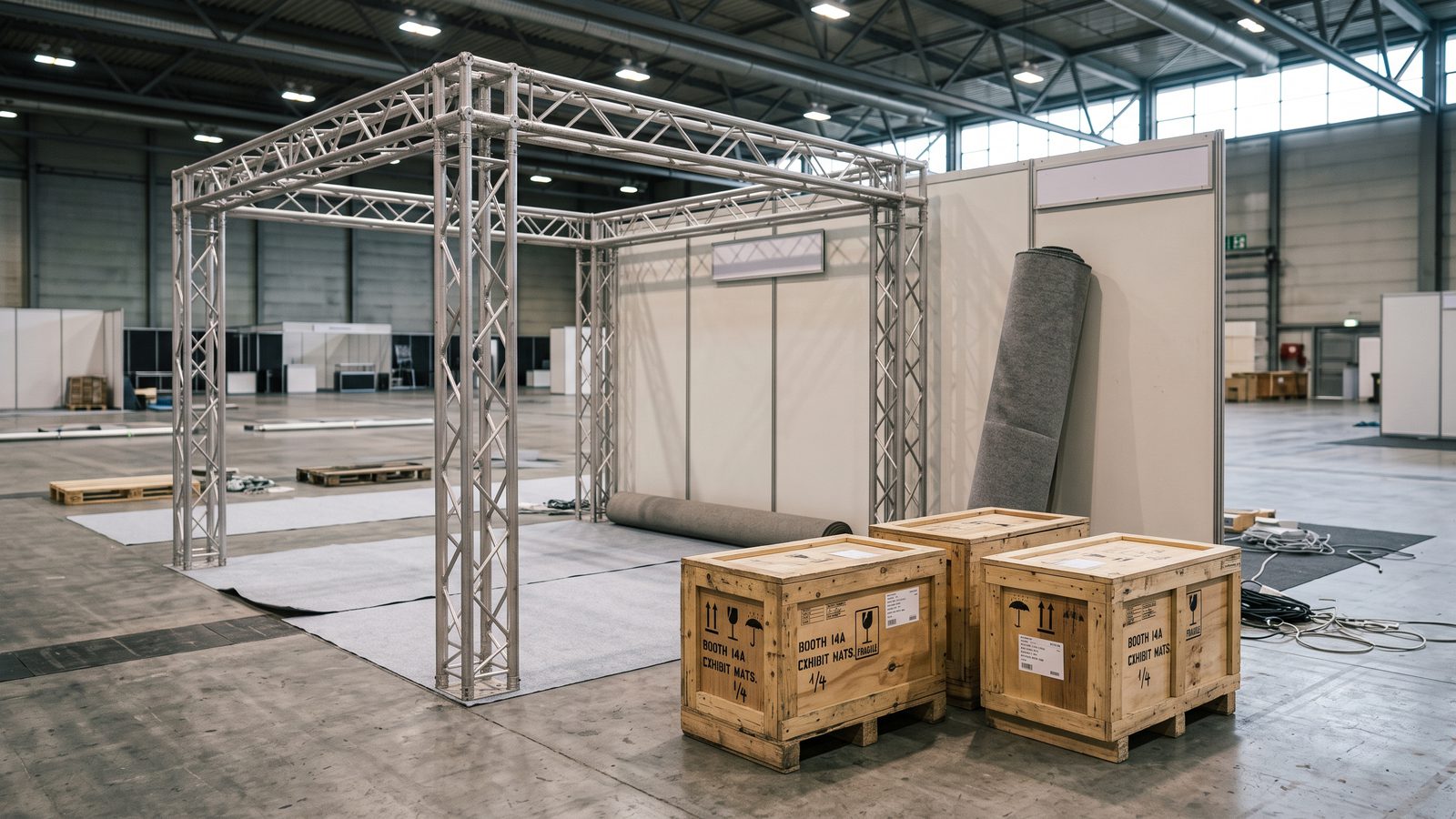
Shipping booth materials and product displays to international trade shows requires careful coordination with both international freight forwarders and the trade show's official drayage contractor. Drayage refers to the handling of exhibit materials from the loading dock of the convention center to the exhibitor's booth space, and from the booth back to the loading dock after the show. In the US, the major drayage contractors are Freeman (official contractor for CES, Natural Products Expo West, and many other shows) and GES (Global Experience Specialists, official contractor for numerous industry-specific shows). Drayage is typically the single largest logistics cost for trade show exhibitors, often exceeding the cost of the international freight itself.
Drayage rates in the US vary by show and contractor but typically range from USD 80 to USD 150 per hundredweight (100 pounds / 45.4 kg) for material handling, with a minimum charge of USD 250 to USD 400 per shipment. A standard 10x10 foot booth with display materials, product samples, and promotional items typically weighs 500 to 1,500 pounds, resulting in drayage charges of USD 400 to USD 2,250 per show. Special handling for oversized items, fragile products, or items requiring forklift delivery incurs additional surcharges of 25 to 50 percent. To minimize drayage costs, Taiwan brands should design booth displays using lightweight materials (fabric graphics, aluminum frames, modular displays) and ship in standard-sized crates that fit on standard pallets.
International freight forwarders experienced with trade show logistics include Agility Fairs and Events, DB Schenker Fairs and Events, and Mainfreight Trade Show Services. These specialized forwarders handle the complete logistics chain from the Taiwan factory to the show floor, including export customs clearance, international shipping (air or sea), import customs clearance (or carnet processing), warehousing at a local facility near the convention center, delivery to the convention center according to the show's advance shipment schedule, and return shipping after the show. Costs for full-service trade show freight from Taiwan to a US trade show typically range from USD 2,500 to USD 8,000 per shipment depending on volume, weight, and shipping mode (air freight for time-sensitive shipments averages USD 5 to USD 8 per kg, versus sea freight at USD 0.50 to USD 1.50 per kg).
On-site show services that must be ordered from the trade show's official service contractors include electrical connections (USD 150 to USD 500 for a standard 120V/20A outlet, with costs increasing significantly for higher-amperage or 220V connections), internet/WiFi (USD 300 to USD 1,200 for the show duration), carpet/flooring (USD 150 to USD 400 for a 10x10 booth), furniture rental (tables USD 80 to USD 150 each, chairs USD 40 to USD 80 each), and lead retrieval scanners (USD 200 to USD 500 per scanner for the show duration). These services must be ordered in advance through the show's exhibitor services portal, and early-bird pricing (typically 30 to 60 days before the show) offers 10 to 20 percent discounts over standard rates. Late orders or on-site orders incur surcharges of 25 to 50 percent.
Booth design and setup for first-time international exhibitors can be handled by the show's official booth design services or by independent exhibit design companies. A professional turnkey booth package for a 10x10 foot (3x3 meter) space, including design, fabrication, graphics, lighting, and installation/dismantling, typically costs USD 5,000 to USD 15,000 from a US-based provider and USD 3,000 to USD 10,000 from a Taiwan-based provider who ships the booth internationally. Many experienced exhibitors invest in a portable modular display system (such as those from Nimlok, Nomadic Display, or Skyline) that costs USD 3,000 to USD 8,000 initially but can be reused for 5 to 10 shows, reducing the per-show cost significantly. Taiwan manufacturers of display equipment can also produce custom booth components at competitive prices for international shipping.
Post-Show Follow-Up and Budget Planning
Post-show follow-up is where the ROI of trade show participation is actually realized. Industry data from CEIR shows that 80 percent of trade show leads that are not followed up within 14 days of the show will never convert to sales, yet the average exhibitor takes 30 to 45 days to initiate follow-up contact. Taiwan brands should prepare their post-show follow-up process before the show begins, including email templates for different buyer categories (distributors, retailers, e-commerce platforms), sample shipment logistics for buyers who requested product samples at the show, and a CRM system or spreadsheet for tracking lead status and follow-up activities.
The post-show follow-up sequence that generates the highest conversion rates is: Day 1-3 after the show, send a personalized thank-you email to every qualified lead with a reference to the specific conversation or product interest discussed at the booth. Day 3-7, ship requested product samples with a cover letter, pricing information, and minimum order quantity details. Day 7-14, schedule a follow-up call or video meeting to discuss the buyer's specific requirements, answer questions, and present a preliminary quotation. Day 14-30, send a formal quotation or proposal based on the buyer's requirements discussed during the follow-up meeting. Day 30-60, conduct a second follow-up to address any remaining questions and push toward a purchase decision or trial order.
Budget planning for international trade show participation should account for all cost categories, many of which are easily overlooked by first-time exhibitors. A comprehensive budget for a single trade show appearance at a major US show includes booth space rental (USD 3,000 to USD 8,000 for a 10x10 foot booth), booth design and construction (USD 3,000 to USD 15,000), international shipping of booth and products (USD 2,500 to USD 8,000), drayage and material handling (USD 400 to USD 2,250), show services including electrical, internet, and furniture (USD 800 to USD 2,500), travel and accommodation for 2-3 staff members for 5-7 days (USD 4,000 to USD 10,000), marketing materials including business cards, brochures, and product catalogs (USD 500 to USD 2,000), post-show sample shipments (USD 1,000 to USD 3,000), and miscellaneous expenses including meals, local transportation, and entertainment (USD 500 to USD 1,500).
The total budget for a single major US trade show ranges from USD 15,000 to USD 50,000, with the most common range for a first-time Taiwan exhibitor with a 10x10 foot booth being USD 20,000 to USD 35,000. Australian and Japanese trade shows are generally less expensive due to smaller booth sizes (3x3 meter standard in Australia and Japan versus 10x10 foot in the US), lower drayage costs, and shorter travel distances from Taiwan. A typical Fine Food Australia or Tokyo Gift Show appearance for a Taiwan brand costs AUD 12,000 to AUD 30,000 or JPY 2,000,000 to JPY 5,000,000, respectively.
To maximize ROI, Taiwan brands should view trade show participation as a multi-year investment rather than a one-time event. First-year exhibitors typically break even or show modest returns, as they are building brand awareness and learning the show's dynamics. Second-year exhibitors benefit from returning buyer relationships, optimized booth design, and refined lead capture processes, typically showing a 2:1 to 3:1 ROI. Third-year and beyond, established exhibitors with strong booth locations (earned through seniority-based booth selection), repeat buyer relationships, and efficient show operations can achieve ROI of 5:1 to 10:1. LNH31 Global recommends committing to a minimum three-year trade show program to realize the full value of the investment, with annual budget allocation of 3 to 5 percent of the target market's projected annual revenue.
Frequently Asked Questions
How far in advance should I start planning for an international trade show?
Begin planning 6 to 9 months before the show date. Book booth space 6 to 8 months in advance (many shows sell out early, and seniority-based booth selection favors early registrants). Apply for the ATA Carnet 6 to 8 weeks before shipping. Ship booth materials by sea freight 8 to 10 weeks before the show (or 2 to 3 weeks for air freight). Order show services at least 30 to 60 days before the show for early-bird pricing. Complete all product compliance certifications for the target market well before the show date.
Can I give away product samples at a trade show using an ATA Carnet?
No, the ATA Carnet covers only goods that will be temporarily imported and re-exported. Product samples that you intend to give to buyers, distribute on the show floor, or leave behind must be shipped separately under normal import procedures with full customs entry and duty payment. Mixing carnet goods with giveaway samples can result in forfeiture of the carnet security deposit. Ship sample inventory separately and budget for applicable import duties and taxes (typically 5 to 15 percent of declared value depending on the product and destination country).
What is drayage and why is it so expensive at US trade shows?
Drayage is the handling of exhibit materials from the convention center loading dock to your booth and back after the show. In the US, drayage is performed exclusively by the show's designated contractor (usually Freeman or GES) under union labor agreements, which is why exhibitors cannot handle their own materials. Rates are USD 80 to USD 150 per hundredweight (100 pounds), with a minimum charge of USD 250 to USD 400. To minimize costs, use lightweight booth materials, ship in standard-sized crates, avoid oversized items, and order advance shipping (which is cheaper than at-show delivery).
What is the typical ROI timeline for trade show investment?
First-year exhibitors typically break even or achieve 1:1 ROI as they build awareness and learn show dynamics. Second-year exhibitors usually achieve 2:1 to 3:1 ROI from returning buyer relationships and optimized operations. Third-year and beyond, established exhibitors can achieve 5:1 to 10:1 ROI with strong booth locations, repeat buyers, and efficient processes. Commit to a minimum three-year program and allocate 3 to 5 percent of target market projected revenue for annual trade show budgets.
Sources & References
- —Center for Exhibition Industry Research (CEIR) -- Index Report 2025: Performance Trends in the Exhibition Industry
- —International Chamber of Commerce -- ATA Carnet System Operational Guidelines 2024
- —Freeman Company -- Exhibitor Services and Drayage Rate Guide 2026
- —TAITRA -- Guide to International Trade Show Participation for Taiwan Exporters 2025
Ready to Enter the US Market?
We turn great products into global sales. Contact us today.
Start a partnershipMore Articles
View All →

Cross-Border Trade
How Trade Shows Generate Export Leads: A Practical Guide for Taiwan Brands
8 min read